Restarting the Local Economy After a Disaster
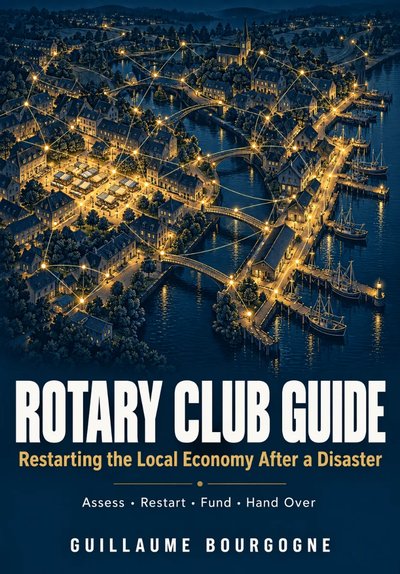
Rotary Club Guide: Restarting the Local Economy After a Disaster
Guillaume Bourgogne, 2026
Assess · Restart · Fund · Hand Over
A bonus book, after the Disaster Field Guide
The Disaster Field Guide helps your club act in the first hours and weeks of a disaster. This book picks up where it stops: once relief winds down, how does a club help the local economy get back on its feet?
Two days after the 2010 earthquake, Haiti's market women were already walking down to the markets of Pétion-Ville. The organizations that came to help chose to import food instead.
After a disaster, whether a community recovers or empties out depends on how fast its own incomes, markets, and businesses start running again. A Rotary club serves recovery when it reconnects that economy, not when it replaces it.
This guide picks up where relief ends. Drawing on more than forty documented real cases, from Christchurch to Joplin, from Haiti to Sri Lanka, it turns international recovery standards (MERS, Sphere, ILO, UNDP, FAO) into decisions a club can make, and it cites the Rotary Foundation rules in force in 2026, with their dates. With it, your club will be able to:
- Assess the economic damage in a few days
- Run every project through a “do no harm” filter
- Restart money, skills, markets, and places
- Fund projects under 2026 Rotary Foundation rules
- Plan monitoring, exit, and handover from day one
“Who used to sell this here before the disaster?”
What you will find inside
- A rapid economic assessment, carried out in person by members local merchants already know, with a field form ready to photocopy
- The signals that tell you when to shift from emergency to recovery
- A five-question “do no harm” filter, applied to every project idea
- The four levers (money, skills, markets, and places) and the order in which to pull them
- How district grants, Disaster Response Grants, and global grants fit together
- How to organize the club, the district, and the action groups, and how to work alongside humanitarian agencies
- Honest monitoring, a planned exit, and a prepared handover of assets
- A recovery file template, a glossary, and an index of cases
The book is also candid about what is not known: Rotary cases of economic recovery are rare in public sources, and none has had an independent evaluation.
Who it is for
Rotary club members, club and district leaders, Foundation, community economic development and disaster committees, and Rotary Action Groups. More broadly, service clubs, community foundations, chambers of commerce and nonprofits that want to support the economy of a disaster-hit area.
Read it online
The full book is available chapter by chapter, free, in the online edition: introduction, fifteen chapters in five parts, conclusion, and appendices A to E. Use the search bar to jump to a case, a checklist or a glossary entry.
A French online edition is also available: Version française.
Download the PDF
Download PDF
Download PDF
Author's edition, 170 × 244 mm, for printing and reading on screen.
Not affiliated with Rotary International
This is an independent work. It is not approved, endorsed, or sponsored by Rotary International or The Rotary Foundation. “Rotary” and the names of Rotary programs are used for descriptive purposes. Rotary Foundation rules change: always check the current version on my.rotary.org before setting up a project.